söndag 25 december 2011

Optical isomeres and amino acids


In terms of chemistry isomers are compounds that have an identical molecular formula but a different structural formula, which means that its atoms are differently geometrically arranged. There are several forms of isomers and one that will be looked more closely into is stereoisomerism.

If you look at your nose in the mirror, the reflection will be identical to your real nose. If you instead would look at you palm in the mirror it would look exactly as your left hand. The reflection is not superposed, which is the reason you cannot fit you left hand into your right glove. An optical isomer (stereo isomer) is a mirror reflection of a compound. All compounds are not able to form optical isomers as the mirror image will be identical to the original object. This is just like the example with the nose, achiral objects. For stereoisomerism to occur, the compound needs to bee chiral. This happens when there is a fixed center with three different groups; atoms or molecules boned to it. These kinds of isomers have identical chemical properties and perform identical chemical reactions. They can only be distinguished in the direction they bend light. 


In biological terms optical isomers can have significantly different behaviors. There was an incident in the late 1950s with a drug called Thalidomide and was used by pregnant women against morning sickness. It resulted in children being born with various deformations which were caused by the optical isomer from of the compound. These are the devastating effects stereoisomerism can have.

All life is based on amino acids, more precise on the optical isomer L-amino acids. Amino acids are chiral which means that there are optical isomers; L-amino acids and D-amino acids. If a pathogen was artificially created that was based on the D-amino acid, all organism on earth would not be able to defend themselves against this microorganism. White blood cells of animals would have no effect against them as they were designed to fight pathogens of the same amino acid build up. If someone would create an organism like this, they would have the power to destroy all life on earth.

Why do grains of pollen move continously in a random motion when placed in still water?


This phenomena can be explained by Brownian motion, which is the random drifting of particles in a liquid.  The kinetic theory states that all matter is made out of particles which are in constant motion in proportion to their energy and attraction between other particles. A particle can consist of atoms, molecules or ions.   

In water or other liquids the attraction between the particles is relatively low, which means that the water molecules can move freely. The grains of pollen move due to the water particles bumping into them causing movement. This is a random physical occurrence, which means that the water molecules can hit the grains of pollens from different directions at any time. 

The observation of grains of pollen moving in a random motion on water was made in 1827 by a botanist called Robert Brown. 

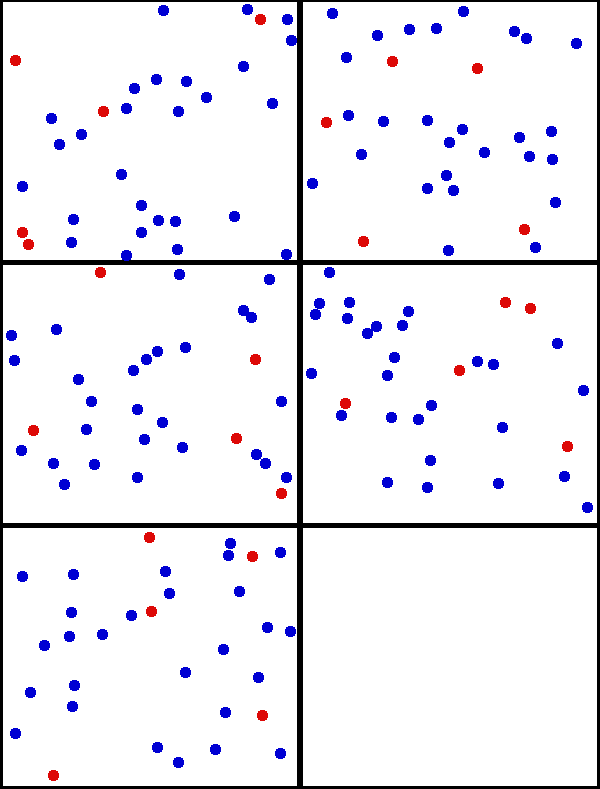
Below is a demonstration of Brownian motion. The red particles represent grains of pollen (out of proportion) being moved around by the blue water molecules.


Why do some objects glow under ultraviolet light?


Materials that glow under ultraviolet light, also called black light are called to be fluorescent. In normal light emission, photons are released from electrons at the same frequency as they were absorbed. In fluorescence materials this is not the case as they emit light at different wavelengths than absorbed. In normal color emission, electrons absorb energy from photons that is required to move up energy levels. As the electrons fall to their ground state they release the energy in the form of photons at the exact same frequency. Ultraviolet light cannot be seen by human eyes as the frequency is outside the visual light spectrum. When fluorescence materials are exposed to this black light they usually reemit photons with a lower frequency that is within the visual light spectrum. The difference in energy is emitted as heat.

Excitation: S0 + hvex --> S1

Emission: S1 --> S0 + hvem + heat

(Where S0 is the ground state and S1 the first energy level)

These materials usually have rigid structures and delocalized electrons. Examples of materials are called white paper, vitamins, body fluids chlorophyll.  

Why are some objects seen as colorless?

In atoms and molecules the electrons surround the nucleus in energy levels. When an electron is not exited it usually occupies the lowest energy level available. When energy is given to an electron it moves up a different amount of energy levels depending on how much energy it gains. The distance between the energy levels decreases further away from the nucleus until the electron completely has escaped the nucleuses attraction. When this occurs, the atom or molecule has been ionized.   

When photons of light hit atoms or molecules, the electrons absorb this energy. In order for electrons to move to the next energy level the light need to be of a minimum frequency. This is as the electrons cannot rest in between energy levels. The amount of energy needed for electrons to move to the next energy levels is called a “quanta”. When electrons fall back to their ground state the same amount of energy is released in form of photons. It takes different frequencies to raise electrons of different atoms and molecules to different energy levels. This is what gives different colors.  

The visible light we see is only a small part of a much larger electromagnetic spectrum. The human eye only interprets a narrow range of frequencies. Photons that travel either below or above these frequencies are seen as colorless. Examples of theses are ultraviolet rays, x-rays and radio waves. Some materials have electrons that require a quantum of energy that is outside the frequencies of visible light. This means that they do not give off any photons and make perfect translucent glass.